
Quick answer: An automatic boom barrier gate controls vehicle access by raising and lowering a horizontal arm across an entrance or exit. It is used at car parks, residential developments, business parks and industrial sites where vehicles must be authorised before entering. The right system balances traffic flow, safety, reliability, integration and whole-life cost rather than purchase price alone.
For UK operators, a barrier is rarely a standalone purchase. It sits inside an access policy that decides who may pass, how visitors are handled and what happens when equipment or power fails. That is why the selection process should start with the entrance itself — lane width, traffic peaks, users and safety obligations — before a model is chosen.

What is an automatic boom barrier gate?
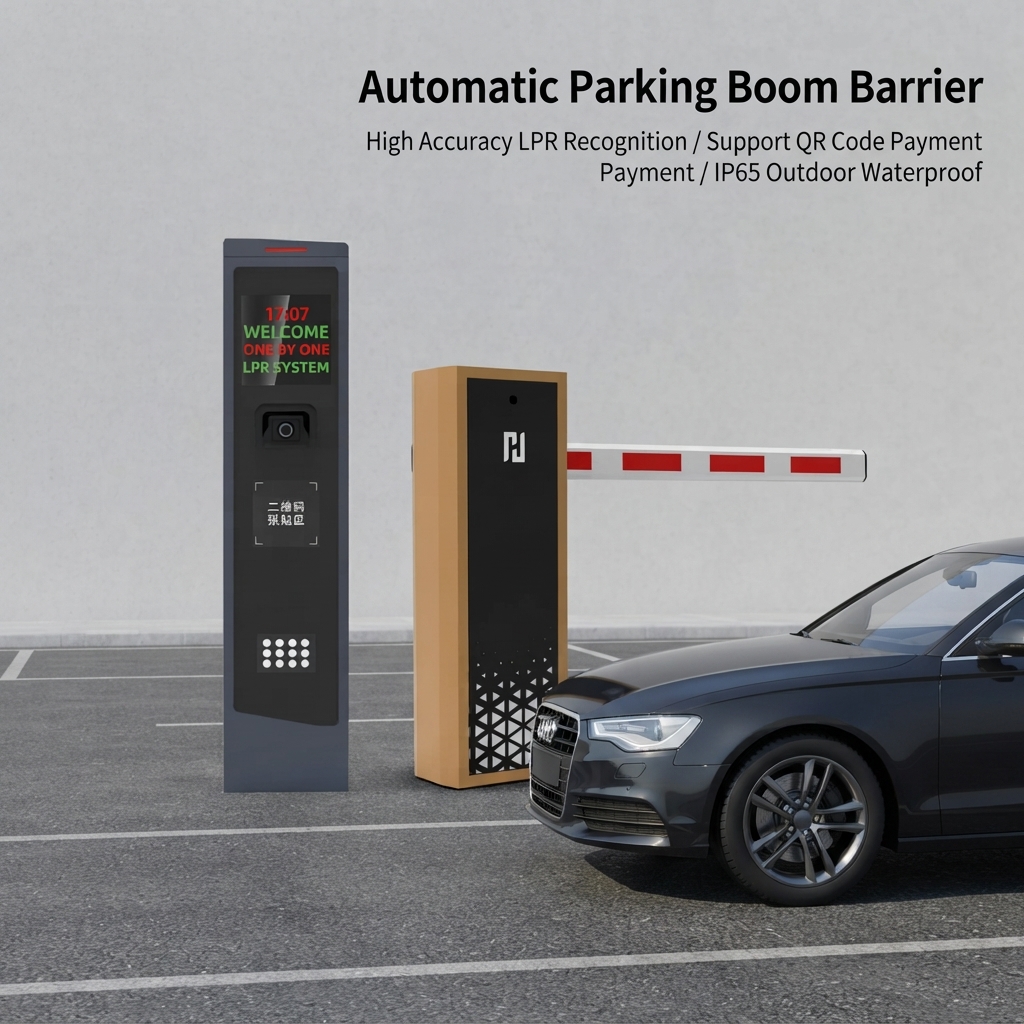
An automatic boom barrier gate is a motor-driven vehicle access barrier. A control unit receives an authorised command from a remote control, push button, access card reader, RFID reader, ANPR camera, ticketing terminal or another compatible access system. The motor then moves the boom arm to the open or closed position. Detection devices and control logic manage vehicle movement and reduce the risk of the arm closing onto a vehicle.
Unlike a full-height gate or a sliding gate, a boom barrier normally controls a single lane with a rising arm while leaving the roadway physically open when the arm is raised. It is therefore particularly suitable for managed entrances where vehicles pass frequently and where a clear visual indication of access status is useful.
Key features to evaluate
Two barriers with similar dimensions can behave very differently in daily operation. The following features determine whether a model suits a specific entrance over several years, not just on the day of installation.
1. Motor and drive system
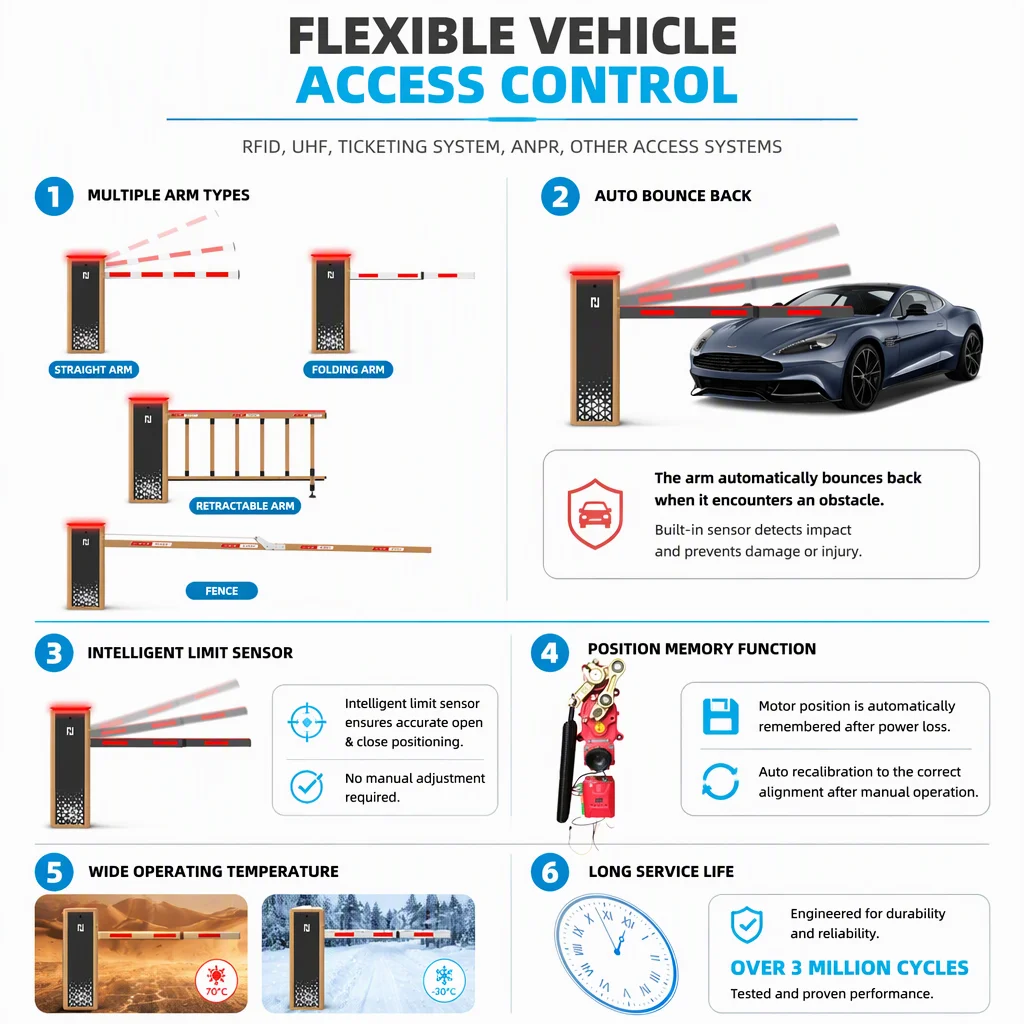
The drive system affects opening speed, noise, operating smoothness and maintenance requirements. Brushless DC drives can suit sites that need controlled movement and frequent operation, while heavy-duty AC configurations may suit other operating conditions. Soft start and soft stop reduce abrupt movement and mechanical stress. Confirm the exact motor type, duty rating, opening time and expected cycle frequency for the model being quoted.
2. Boom arm length and configuration
The arm must suit the clear width of the lane and the physical layout around the barrier cabinet. Measure the usable roadway width, kerbs, islands, posts, turning paths and any nearby pedestrian route before selecting the arm. Straight arms are common for standard vehicle lanes; folding or other specialised configurations may be appropriate where overhead clearance is restricted. Never choose an arm length from the nominal road width alone — confirm the manufacturer's supported configuration.
3. Opening speed and traffic throughput
Opening time influences queue length, especially at shift changes, busy retail periods, logistics sites and multi-storey car parks. A faster barrier is not automatically the best choice: the speed must suit the arm length, safety equipment, traffic pattern and stopping distance. Estimate peak-hour vehicle movements and check whether the proposed model is rated for the expected cycle rate. For HGV entrances, allow enough room for vehicles to stop, be identified and clear the arm safely.
4. Safety detection and obstacle protection
Safety should be specified as a system, not assumed from the presence of a motorised arm. Depending on the site design and selected model, protection may include vehicle loops, radar detection, photocells, pressure-sensitive devices or other approved sensors. The installer should define how the barrier behaves when a vehicle is underneath the arm, when a detector fails and when power is lost. Risk assessment, correct positioning, commissioning and routine testing are essential.
5. Access-control integration
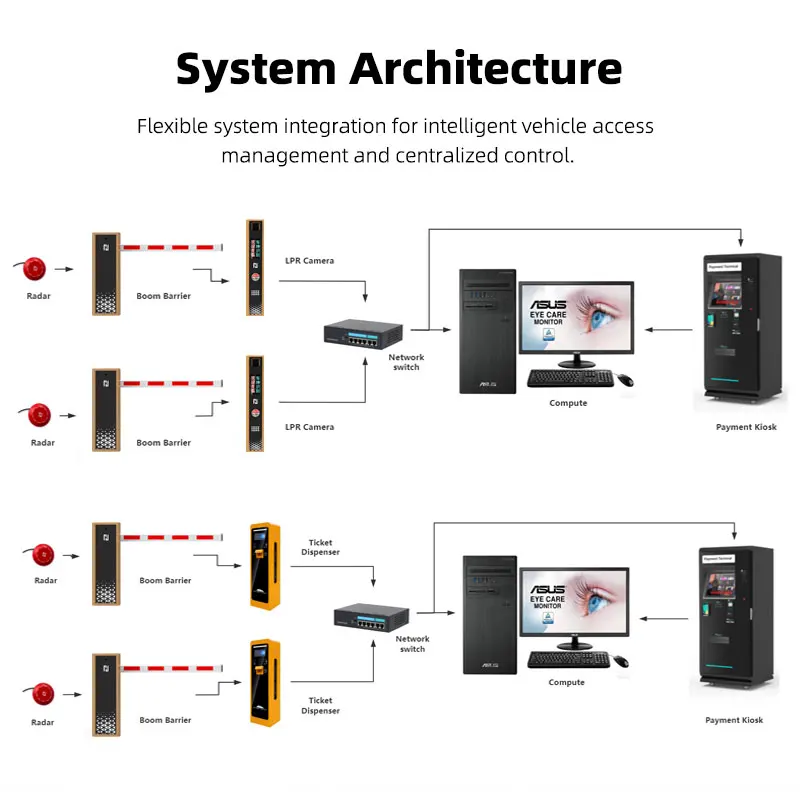
A barrier can operate as a standalone remote-controlled unit or as part of a wider access-control system. Common integrations include ANPR (automatic number plate recognition), RFID credentials, proximity cards, intercoms, ticket dispensers, payment terminals and parking management software. Check the controller's actual interfaces and protocol support — such as relay inputs, Wiegand, RS485 or TCP/IP — against the devices already installed on site. An interface being available does not, by itself, guarantee compatibility with every third-party product.
6. Weather resistance and installation environment
Outdoor barriers in the UK may be exposed to rain, wind, damp conditions, temperature changes, road spray and dirt. Review the specified ingress-protection rating, cabinet finish, corrosion resistance, drainage and installation instructions for the exact model. A weather-resistant rating does not remove the need for suitable foundations, cable protection, drainage and periodic inspection. Coastal or industrial environments may require additional consideration.
7. Manual release and power-failure arrangements
Ask how authorised staff can operate the barrier during a power cut, control-board fault or maintenance visit. Depending on the model, a manual release or clutch may be provided, but the procedure must be documented and accessible to trained personnel. If the entrance is safety-critical, consider the site's emergency access plan, backup power requirements and the consequences of the barrier remaining open or closed.
8. Maintenance, warranty and spare parts
Compare warranty terms, the availability of replacement arms and control components, technical documentation, commissioning support and the supplier's fault-diagnosis process. A lower initial price may not represent the best value if parts are difficult to obtain or downtime is costly. Ask for the maintenance schedule and the list of consumable or wear-prone components before placing the order.
Typical UK applications
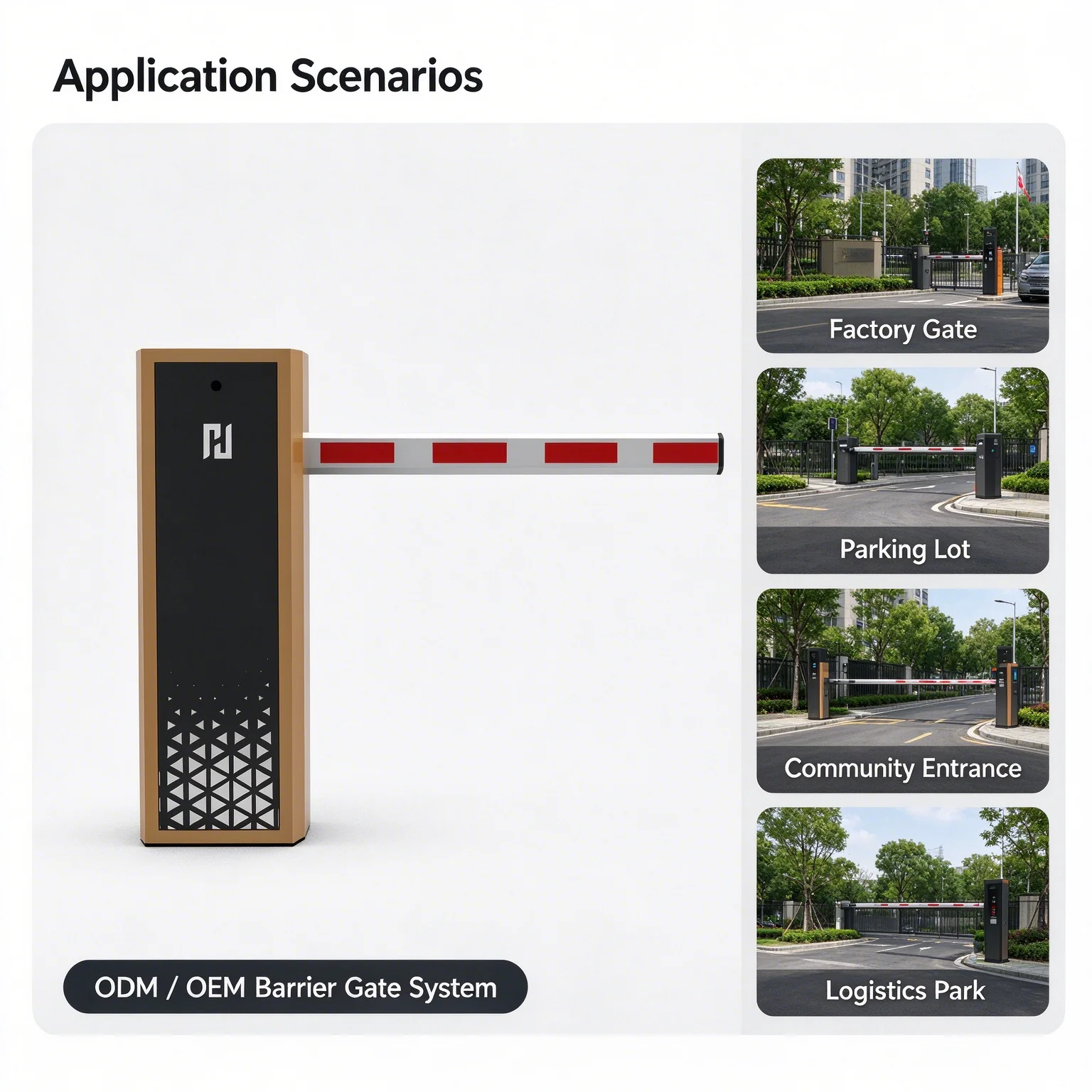
The same barrier model can perform very different roles depending on the site. Access rules, traffic peaks and the mix of users should drive the specification, not the other way around.
Commercial car parks and retail destinations
Automatic boom barriers can control entry and exit lanes, support ticketed or ticketless parking, and help operators manage authorised access. At busy retail destinations, the design should account for peak arrival periods, pedestrian crossings, payment processes and the safe storage of queues within the site boundary.
Residential developments and gated communities
For flats, private estates and gated communities, barriers can be linked to resident RFID tags, access cards, intercoms or approved visitor procedures. Low noise, clear visitor handling and a safe arrangement for pedestrians and cyclists are particularly important in residential settings.
Business parks and office buildings
Business parks may need to distinguish between employees, visitors, contractors and deliveries. Integration with an existing access-control platform can reduce manual checks, provided the barrier controller and software are confirmed to work together. Separate entry and exit lanes can also make traffic movements easier to manage.
Industrial sites and logistics facilities
Factories, depots and distribution centres may have frequent van and heavy goods vehicle movements. These sites should prioritise duty rating, robust installation, suitable arm configuration, detection coverage and a traffic layout that allows larger vehicles to queue and turn without obstructing public roads.
Hospitals, schools and public-sector premises
Hospitals, schools, leisure venues and public-sector sites may have a mixture of staff, visitors, service vehicles and emergency access requirements. The access policy should be agreed before equipment selection, including how authorised emergency vehicles are admitted and how pedestrian routes remain separate from vehicle movements.
How to choose the right automatic boom barrier gate
A structured selection process reduces the risk of buying a barrier that is either undersized for the traffic or unnecessarily complex for the site.
Step 1: Survey the entrance
Record the clear lane width, available cabinet position, kerb and island layout, overhead restrictions, ground conditions, drainage, power availability and cable routes. Check whether vehicles approach straight on or at an angle, and whether pedestrians or cyclists cross the vehicle route. Site measurements should be confirmed before the arm length and foundation are finalised.
Step 2: Define traffic volume and duty cycle
Estimate normal and peak-hour traffic, the number of opening and closing cycles per hour, and whether operation is occasional, regular or near-continuous. Select a model whose published duty rating and speed match the real operating profile. Avoid relying on a headline opening-time figure without checking the conditions under which it was measured.
Step 3: Choose the access method
Decide whether drivers will use a remote control, access card, RFID tag, ANPR camera, intercom, ticket or payment system. For mixed-use sites, specify how visitors, contractors, deliveries and emergency vehicles will be handled. Confirm the required inputs, protocols, software interfaces and data-handling responsibilities with the relevant suppliers.
Step 4: Specify safety measures
Ask the installer to provide a risk assessment and a clear description of detection zones, closing logic, emergency operation and commissioning tests. Ensure that the design addresses vehicles, motorcycles, bicycles and pedestrians where relevant. Safety devices must be compatible with the controller and installed, tested and maintained according to the manufacturer's instructions and applicable UK requirements.
Step 5: Check the specification and documentation
Request the exact model number and written specification, including supported arm length, opening time, motor and duty rating, power supply, environmental rating, interfaces, included accessories, warranty, lead time and installation requirements. For UK projects, ask the supplier to confirm the applicable product marking and conformity documents for the precise model and intended installation. Do not assume that one marking or certificate automatically covers every site-specific legal obligation.
Step 6: Compare whole-life cost
Compare the purchase price alongside installation, foundations, cabling, access-control integration, commissioning, planned maintenance, replacement parts and potential downtime. Ask for a clear breakdown of what is included in the quotation. The most suitable barrier is the one that meets the site requirements safely and reliably at an acceptable whole-life cost.
Automatic boom barrier gate vs other access solutions
An automatic boom barrier is generally a practical choice when the objective is to control vehicle flow at a defined lane while allowing rapid passage when authorised. A sliding or swing gate may be more appropriate where a physical gate leaf is required for perimeter closure. Bollards may be considered where a different form of vehicle restriction is needed. The decision should be based on the threat model, traffic pattern, space, safety assessment and site operation — not on product labels alone.
| Solution | Typical strength | Consider when |
|---|---|---|
| Automatic boom barrier | Fast, visible lane control with simple integration | Vehicles must be checked individually at a defined lane |
| Sliding or swing gate | Physical perimeter closure with a full gate leaf | The site boundary itself must be closed, not only a lane |
| Rising bollards | Discreet vehicle restriction with flexible lane use | Pedestrian areas or high-security frontages need occasional vehicle blocking |
| ANPR-only control | Ticketless, hands-free identification | Plates are reliable and exceptions can be handled remotely |
Installation and maintenance considerations
A reliable installation begins with a suitable foundation and correct positioning of the cabinet, boom arm, detectors and access-control equipment. Cable routes should be protected, the arm movement should be clear of surrounding structures, and the installation should not create an unsafe conflict between vehicles and pedestrians. Commissioning should test normal operation, authorised and unauthorised commands, safety detection, manual release and the documented response to faults or power loss.
Routine maintenance should follow the model-specific manual and site conditions. Typical checks include arm fixings and balance, cabinet security, fasteners, detector operation, control settings, signs and lights, manual release and the condition of cables and foundations. Record inspections and faults, isolate the equipment before work where required, and use competent personnel for electrical and mechanical servicing.
Frequently asked questions
How wide a lane can an automatic boom barrier control?
The supported lane width depends on the barrier model and arm configuration. Some Baroxon product listings describe configurations in the 3–6 metre range, while specialised products may differ. Confirm the exact supported arm length and any restrictions with the supplier before specifying a system.
Can an automatic boom barrier work with ANPR?
It can be integrated with an ANPR system when the camera, controller and access software have compatible outputs and logic. The project specification should define how number plates are enrolled, how exceptions are handled, and what happens if recognition or the network is unavailable.
Is a faster barrier always better?
No. A faster opening time may help throughput, but the correct choice depends on arm length, traffic volume, safety arrangements, vehicle approach and the model's rated duty. Compare the full operating specification rather than speed alone.
What should UK buyers confirm about compliance?
Ask for the exact model's applicable product marking, declaration and test documentation, installation instructions and any project-specific requirements. Where a project specifies UKCA marking or a particular British Standard, confirm the requirement and documentation with the supplier before ordering. Site design and installation duties may extend beyond product documentation.
How often does a boom barrier need maintenance?
The interval depends on the model, cycle frequency, environment and manufacturer's instructions. Busy or exposed installations may need more frequent inspection. Follow the service schedule for the exact model and record checks, faults and repairs.
Conclusion
Choosing an automatic boom barrier gate is a site-engineering decision as much as a product purchase. Start with lane measurements and traffic demand, then assess drive performance, arm configuration, safety detection, access-control compatibility, weather exposure, maintenance support and compliance documentation. A well-specified system helps UK organisations manage vehicle access more consistently while supporting safe, efficient site operations.
To compare models and configurations for your entrance, review our automatic boom barrier range, or contact Baroxon to discuss lane widths, duty cycles and access-control integration for your project.